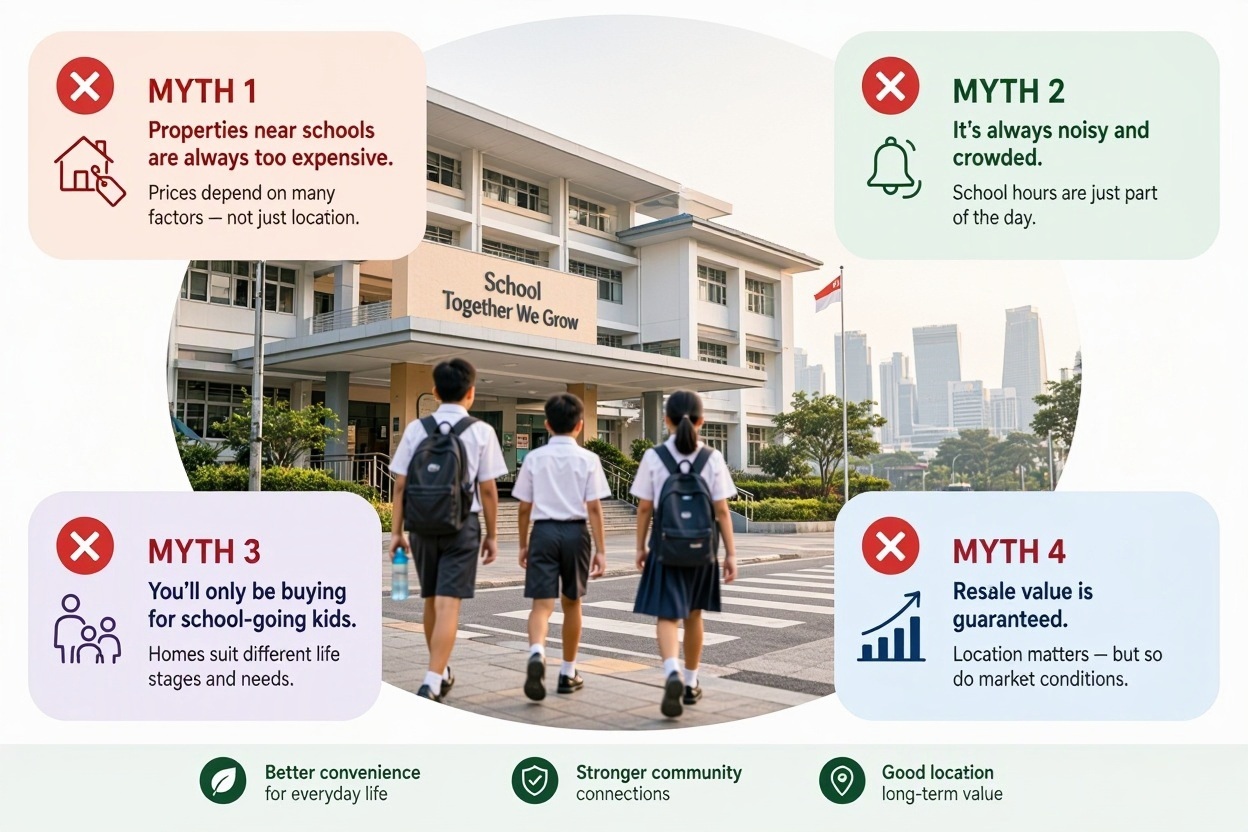
Few things tempt a family buyer more than a home within sight of a school gate. The logic feels airtight: live close, get in, save on commuting. Reality is messier. Admission rules, school capacity and your child’s own circumstances all play a part. Here are four common beliefs about school proximity, and what is actually going on.
Myth 1: Living Next to a School Guarantees a Place
It does not. Primary school registration in Singapore runs through the Ministry of Education (MOE) in phases, and when a school has more applicants than vacancies in a phase, a ballot decides. Home-to-school distance can give priority at certain stages, usually in bands, but it never overrides the balloting process. Popular schools can be oversubscribed even among nearby residents.
The safer mindset is to treat proximity as one factor that may help, not a promise. MOE publishes the registration phases each year, so read the current rules rather than relying on hearsay from agents or neighbours.
Myth 2: Straight-Line Distance Is the Only Measure
Many listings quote how far a school is in a straight line, and that figure can be useful. But for admission, MOE uses its own method for recognising a home address and measuring distance, and the rules can change. For daily life, what matters more is the real route: pavements, crossings, bus stops and how safe the journey feels for a young child.
Before relying on any number, ask yourself three things. Is the walk sheltered? Are there busy roads to cross? Could an older sibling or grandparent do the trip comfortably?
Myth 3: Only Primary Schools Matter
Families often forget that needs change. A child who starts Primary 1 will, within six years, move on to secondary school. A home that suits one stage should ideally work for the next. Looking at secondary schools, enrichment centres, libraries and sports facilities in the wider area gives a fuller picture than fixating on a single gate.
Myth 4: A Nearby School Always Lifts Property Value
Some buyers assume that an address near a well-known school will always command a premium. In practice, demand shifts, school popularity changes and policies are updated. Treat any claim about future pricing with caution. A home should make sense for how you live, not rest on predicted appreciation.
Putting It Into Practice With Two Northern Projects
Two planned developments in the north illustrate how to read school information sensibly.
The mixed-use project Chencharu Central Residences in Yishun lists Peiying Primary School at about 0.26km and Naval Base Secondary School at about 0.41km, according to its project website. Those are reported straight-line figures, and the website itself notes that admission depends on MOE balloting rules and is never guaranteed by proximity. Because the site is still being planned, entrances and walking links have yet to be shown.
Further west, the planned executive condominium Fablewoode Residences on Sembawang Road is described in analyst commentary as having Ahmad Ibrahim Primary School and Yishun Primary School within roughly one kilometre. These are described as bands rather than measured distances, which is a good reminder to verify before you rely on them. Launch timing, floor plans and official pricing for this project remain to be announced.
In both cases, the sensible next step is the same: check the official MOE tools and your own eligibility, not just the brochure.
A Practical Checklist for School-Minded Buyers
- Look up the current MOE registration phases and how distance is treated.
- Identify two or three schools in the area, not just one.
- Walk the route at school hours to see traffic and crowding.
- Consider after-school care, tuition and enrichment options nearby.
- Think about how the commute changes as your child grows older.
- Keep a financial buffer so the purchase does not depend on a single school outcome.
The Takeaway
Proximity to a school can make family life easier, and it may improve your chances in certain registration phases, but it is not a ticket in. Balance it against budget, transport, space and long-term plans. Buyers who weigh the whole picture usually end up happier than those who bought for a single gate.